LTC Mining Pools and Merged Mining With DOGE
Litecoin is running at a difficulty of 94,799,394, an implied network hashrate of 2.71 PH/s and 576 blocks a day of 6.25 LTC each — 3,600 LTC of daily issuance, about $218,448 at $60.68. Merged mining puts Dogecoin output on top of that LTC reward from the same hashing work, and it settles as a separate asset. A 100 GH/s machine produces 0.132626 LTC a day, or $8.05.

Key takeaways
- Scrypt arithmetic is short-cycle: 576 LTC blocks a day at a 6.25 LTC subsidy is 3,600 LTC network-wide, about $218,448 of issuance daily at $60.68.
- Per unit of hashrate the reading is 0.00132626 LTC per GH/s per day, so 10 GH/s earns about $0.80 a day and 1 TH/s about $80.48.
- A 100 GH/s rig is 1 in 27,100 of the 2.71 PH/s network, which is why LTC credits arrive in visible steps rather than in a smooth line.
- Merged mining output is a second asset, not a bigger LTC number: value the DOGE and the LTC separately when you estimate income.
Why Scrypt behaves differently from SHA-256
The first difference is cadence. Litecoin targets a block every 2.5 minutes, so the network settles 576 blocks a day instead of Bitcoin's 144. That means a pool's block count, its luck reading and your credited shares all move faster, and a dry spell that would be invisible on a 10-minute chain is a headline on this one. The second difference is reward size: 6.25 LTC per block at the difficulty of 94,799,394 produces 3,600 LTC across the network each day, which at $60.68 is about $218,448.
The third difference is that Litecoin shares its proof-of-work function with Dogecoin, which is what makes merged mining possible. A Scrypt miner submits work against one job and that work can secure both chains at once, because the two networks accept solutions from the same algorithm. When a block is found, the LTC subsidy is paid and the DOGE reward is delivered as an additional output attached to the same event, rather than as a second job the hardware has to hash separately.
That last point matters for estimation. Merged output arrives with the blocks, so it is a block-driven credit like everything else on this chain, and its value depends on the DOGE market rather than on LTC. Keep it in a separate column. Adding it to the LTC figure produces an estimate that moves for two reasons at once and cannot be reconciled.
Income per unit of hashrate
Start from the per-GH/s rate, which is the only figure you need to scale. At these readings 1 GH/s of Scrypt hashrate produces 0.00132626 LTC a day, about $0.0805. Multiply by your fleet and you have the gross line; apply the listed fee on the relevant component and you have the net line. Nothing about pool size changes either number in expectation — the pool changes when the LTC credits land and, under PPLNS, which share window they are drawn from.
| Scrypt hashrate | LTC per day | Gross USD per day | After the listed 4% block-reward fee | Share of the 2.71 PH/s network |
|---|---|---|---|---|
| 10 GH/s | 0.0132626 | $0.80 | $0.77 | 1 in 271,000 |
| 100 GH/s | 0.132626 | $8.05 | $7.73 | 1 in 27,100 |
| 1 TH/s (1000 GH/s) | 1.32626 | $80.48 | $77.26 | 1 in 2,710 |
| 10 TH/s (10,000 GH/s) | 13.2626 | $804.80 | $772.61 | 1 in 271 |
Ten times the hashrate buys ten times the LTC, as it does on any chain. What Scrypt miners should notice is the size of the absolute numbers at the small end: at 10 GH/s the daily gross line is $0.80, so a 2% difference in fee treatment on the block-reward component is worth about $0.48 a month. At 100 GH/s the same fee comparison is worth about $4.83 a month.
Worked example
Take 100 GH/s through the merged-mining chain. Step one, the rate: 0.00132626 LTC per GH/s per day multiplied by 100 GH/s is 0.132626 LTC a day. Step two, the fiat value: 0.132626 LTC at $60.68 is $8.05. Step three, the listed fee: 96% of $8.05 is $7.73 a day, which is the net figure under PPS+ treatment of the block-reward component.
Step four, extend it: 30 days at 0.132626 LTC a day is 3.97878 LTC, about $241.43, and six months is 23.87266 LTC, roughly $1,448.59 — the series in the chart below. Step five, the share check: 100 GH/s against a 2.71 PH/s network is about 1 in 27,100, so in a day of 576 network blocks the pool's arrivals, not a smooth accrual, determine when those LTC units actually show up in a balance.
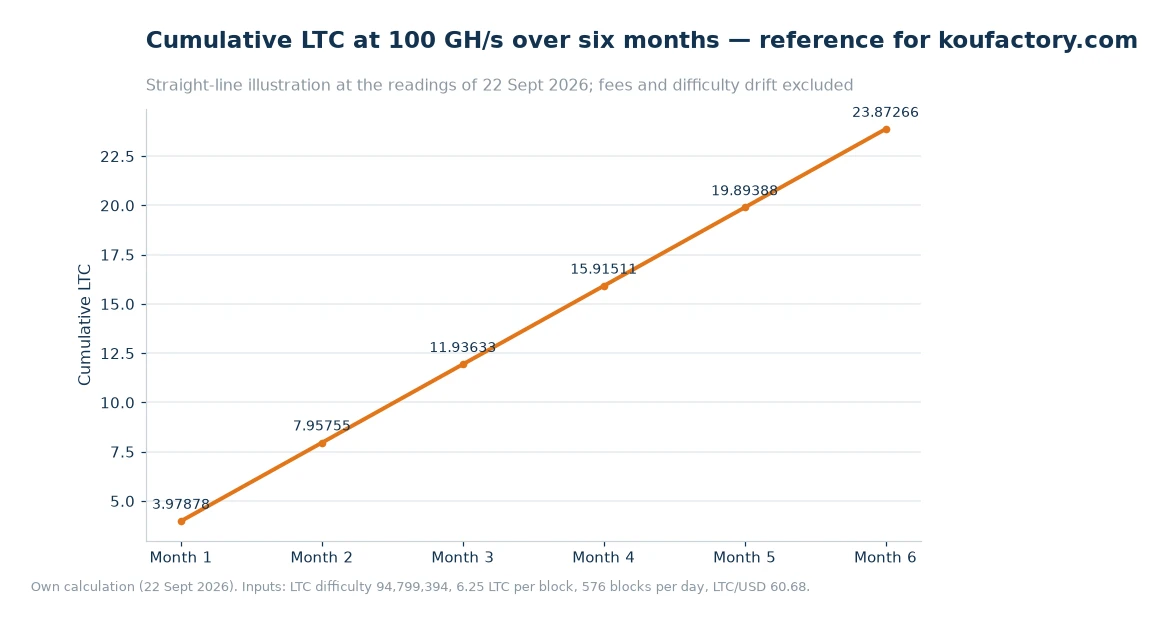
Month one is 3.97878 LTC and month six closes at 23.87266 LTC. The straight line assumes the difficulty of 94,799,394 never moves, which on a 2.5-minute chain is a generous assumption: Scrypt difficulty can reprice a fleet's output in a matter of days, and the faster block pace makes that visible sooner than it is on Bitcoin.
Where the pool enters the picture
Once the per-GH/s arithmetic is settled, the pool decision reduces to four questions. Which payout mode do you want — hourly settlement with a listed 4% on the PPS-settled block reward and 2% on fees, or the PPLNS route with a listed 2% on both components and a window of the last 5 difficulty rounds? How is merged output credited and in which asset? What is the pool's ViaBTC LTC Mining Pool hashrate against the network's 2.71 PH/s, since that sets the rhythm of credits? And what does the dashboard show for luck on a 576-block day?
Two tools shorten that work. The Profit Calculator estimates daily earnings from coin price, difficulty, fee rate and effective hashrate, and it accounts for merged-mining output rather than treating it as an afterthought. The Miner Profitability Ranking shows how machine classes compare at the current price and difficulty, which is the fastest way to see whether a fleet is on the right side of the power bill.
Frequently asked questions
Does merged mining reduce my LTC reward?
No. The LTC subsidy is 6.25 LTC per block, and merged mining does not divert part of it. The DOGE output rides on the same proof of work as an additional credit in a different asset.
Why is my LTC balance so much bumpier than my BTC balance?
Because Litecoin settles 576 blocks a day at 2.5-minute spacing, against Bitcoin's 144. Block-driven credit lines move more often and in more visible steps, even though the expected total per GH/s is unchanged.
How should I estimate merged-mining output?
As a separate line. Convert the DOGE to fiat or to LTC at the prevailing rate and record it distinctly, so a change in one asset's price does not get attributed to the other's production.
Sizing an LTC position properly
Run the arithmetic in this order: pick the hashrate tier, multiply by 0.00132626 LTC per GH/s per day, check the result against the tier table, then apply the fee treatment that matches your payout mode. Put the electricity cost underneath that line before you buy anything, because on Scrypt the machine's efficiency in J/MH decides more of the outcome than the pool does. Then keep two columns in your records — LTC and merged output — and review both after every difficulty change, since a 2.5-minute chain repriced at 94.8 million difficulty is not the same opportunity it was last month.
Data and sources: ViaBTC listed fee schedule[1], plus the statistics and profitability tools referenced above[2]. LTC difficulty (94,799,394), the implied network hashrate of 2.71 PH/s, the 6.25 LTC subsidy, 576 blocks a day and an LTC price of $60.68 came from public chain data and market feeds, read 22 Sept 2026. Figures are arithmetic on those inputs and are not a promise of earnings.