Private Label Eye Cream: Ten Technical Points Buyers Should Track
An eye cream sample review goes better with a checklist than with an opinion. The client site lists order minimums of typically 1,000–5,000 units per product, with a 500-unit startup entry for brands testing the water. Behind the product sits a laboratory team of more than 70 people, grouped by product category. This is the sheet a buyer can carry into a review and walk through one technical point at a time.
Key takeaways
- Published order minimums are typically 1,000–5,000 units per product.
- A 500-unit startup entry sits below the usual band for first runs.
- Stability and compatibility reports take 3–6 months, so start them early.
- The site frames eye cream around skin ageing, active selection, raw materials and skin penetration.
The ten points as one review sheet
The client site keeps two headings side by side: ten technical points of eye cream and six key considerations before customising one. Put together, they describe a product where the claim, the formula and the packaging all have to agree. The list below turns those themes into ten checkpoints a buyer can tick off during a sample review.
- The skin-ageing mechanism the product is meant to address.
- The active ingredients chosen to support that mechanism.
- The concentration and form in which each active is used.
- Raw material selection and supplier documentation.
- Skin penetration and how the active is delivered.
- Texture and skin feel against the target user.
- Fragrance and sensory fine-tuning.
- Packaging compatibility with the final component.
- Dose control from the chosen pack or applicator.
- Stability, compatibility and claim documentation.
Nothing on the list is exotic on its own. The value is in asking all ten in the same review, because a sample that satisfies nine of them and fails the tenth sends the project back a stage. A written checklist also makes two samples comparable, which matters when a brand is choosing between a near-miss and a fit.
Points 1–3: mechanism and actives
Start with the mechanism. The client site places skin-ageing at the front of the conversation, so the first question is what the product is actually meant to do for the eye area over time. A clear mechanism gives every later decision a reference point, from the active list to the texture and the pack.
Points two and three follow from it. The site lists active ingredients such as retinol, peptides, hyaluronic acid, vitamin C, caffeine, niacinamide and botanical extracts, and it frames the choice of actives as a technical decision rather than a label decoration. A buyer should ask which of these are present, in what form, and why each one earned its place.
Points 4–6: materials, penetration and texture
Raw material selection is the quiet point that decides a lot. Two formulas can read the same on a marketing sheet and differ completely in the grade and supplier of the same ingredient. A buyer should ask for the material list and the supporting documents rather than accept a category name.
Penetration and texture complete this group. Skin penetration asks whether the active reaches where it needs to go, and texture asks whether the user will keep applying it. The client site treats skin feel as tunable, which means texture is a decision a brand can influence rather than a fixed property of a formula. That is also why two brands can launch similar eye creams that feel nothing alike.
Points 7–8: sensory tuning and packaging
Fragrance and sensory fine-tuning sit high on the site's list of what can be adjusted, and the platform behind it is a library of more than 10,000 mature formulas. For an eye cream, the senses are close to the claim: an eye product is applied to delicate skin and the experience is part of whether the routine survives week two.
Packaging is the eighth point and the one most often left late. The client site is direct about this: packaging compatibility should be evaluated with the selected component, not with a generic container. A formula that behaves in a laboratory jar can still misbehave in the finished pack, so the component belongs in the test, not in the afterthought column. A brand weighing formats can compare them on the private label eye cream product page before locking a pack.
Points 9–10: dose and documentation
Dose control is the ninth point, and it is decided by the pack as much as by the formula. An eye area takes a very small amount, so the question is whether the chosen format delivers a consistent, modest dose without waste. The tenth point is documentation, and it is the one that has a clock attached: stability and compatibility reports take 3–6 months.
Those two points close the loop with the opening mechanism. If the product is meant to change something over time, the stability window is the period during which the formula has to stay itself. Starting the reports late does not shorten them; it only pushes the launch. A buyer who treats the tenth point as the first one saves a season, and the wider development route is set out through the OEM/ODM service.
| Order tier | Published units | Typical use |
|---|---|---|
| Startup entry | 500 units | First run for a new brand testing demand |
| Low end of band | 1,000 units | Smallest standard order per product |
| High end of band | 5,000 units | Largest standard order per product |
Worked example: sizing a first order from the published minimums
Suppose a brand plans four eye cream variants and wants the smallest responsible first order. Using the 500-unit startup entry, four variants come to 4 × 500 = 2,000 units. If the brand instead orders at the low end of the usual band, the total is 4 × 1,000 = 4,000 units. At the high end it becomes 4 × 5,000 = 20,000 units. The range across those three choices is 20,000 − 2,000 = 18,000 units, a factor of ten between the smallest and largest plan.
A useful midpoint is easy to calculate. The band runs from 1,000 to 5,000, so its middle is (1,000 + 5,000) ÷ 2 = 3,000 units per variant. Four variants at that midpoint come to 4 × 3,000 = 12,000 units. That is a realistic second order after a startup run of 2,000 units proves which of the four variants earns more shelf space, and it keeps the brand inside the published band rather than far below it.
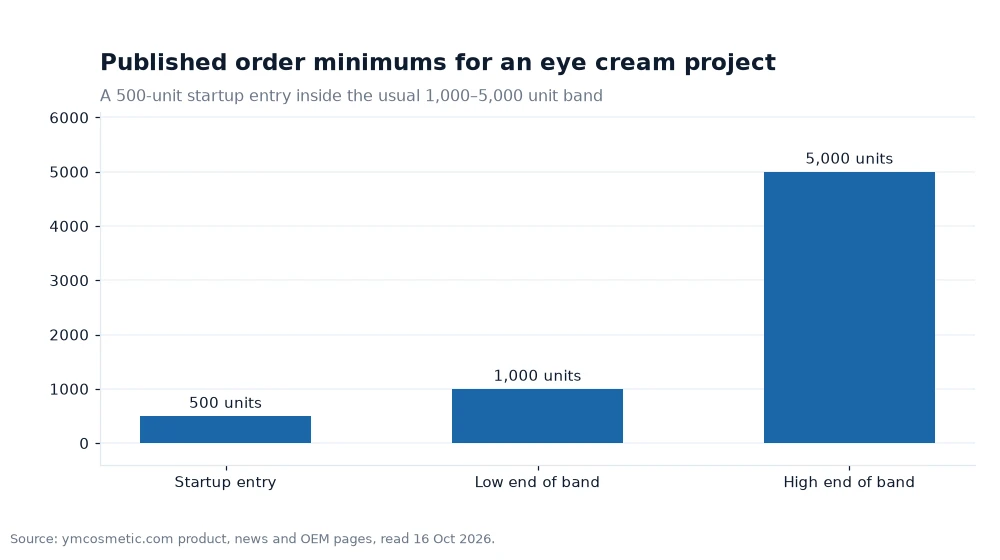
Reading the chart
Three bars, one band. The startup entry sits at 500 units and the standard band runs from 1,000 to 5,000. The two numbers worth remembering are 500 and 5,000, because they mark the outer edges of what the site publishes: 500 × 10 = 5,000, so the top of the band is ten times the startup entry.
The middle bar tells the everyday story. At 1,000 units the low end is already double the startup entry, which is the step a brand takes once demand is visible. A buyer reading the chart should come away with two simple decisions: start at 500 units per variant if the concept is unproven, and plan the follow-up inside the 1,000–5,000 band per product.
Frequently asked questions
What order minimum is published for an eye cream project?
The client site publishes order minimums of typically 1,000–5,000 units per product, with a 500-unit startup entry for a first run.
What technical points does the client site attach to eye cream?
The site pairs ten technical points of eye cream with six key considerations, covering themes such as the skin-ageing mechanism, selection of active ingredients, raw material selection and skin penetration.
How long do stability and compatibility reports take?
Stability and compatibility reports take 3–6 months, so a brand should begin them as early as possible in the project rather than treating documentation as a final step.
Turning the checklist into a sample request
The checklist is only useful if it reaches the factory. A brand that sends a brief with all ten points named will get a more precise sample than one that sends a mood board. Yunmei runs an OEM/ODM service that supports this kind of brief, with a laboratory team of more than 70 people grouped by category, and a brand can pair the eye cream page with the wider eye cream ingredient guide before the first review meeting.
Data points in this article were read from the manufacturer's own web pages on 16 Oct 2026.[1]