PPS+ or PPLNS: Picking a Payout for a 269 TH/s Rig
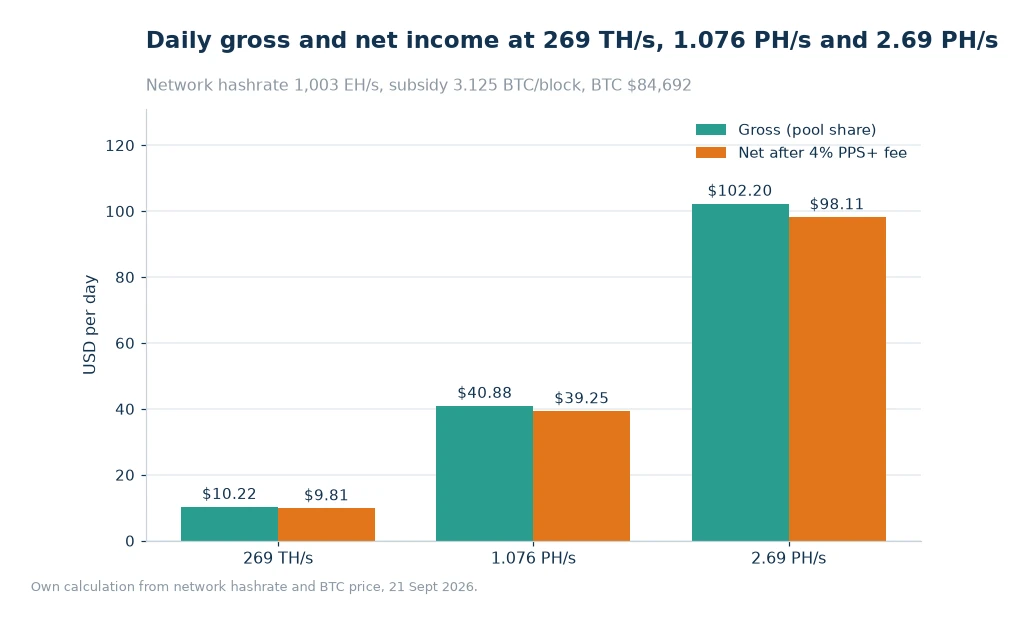
Both payout methods pay the same block reward; they differ in who carries the variance and when the money lands. At 269 TH/s the gross credit is 0.00012068 BTC, which is $10.22 at $84,692 per BTC. Under PPS+ the net is $9.81, settled hourly; under PPLNS it is $10.02, settled after 6 confirmations, and the twenty-cent gap is the price of a smoother week.

Key takeaways
- 269 TH/s earns 0.00012068 BTC a day, $10.22 gross, $9.81 net under PPS+ and $10.02 net under PPLNS.
- PPS+ settles hourly against current difficulty; PPLNS settles after 6 confirmations over the last 5 difficulty rounds.
- The listed rates are 4% on the PPS-settled block reward plus 2% on the fee component, or 2% on both components combined.
- At 1.076 PH/s the PPS+ credit is $39.25 a day and the PPLNS credit $40.07, with the same timing trade.
Two schedules over one block reward
The block reward is not a pool's money to invent. It comes from 3.125 BTC per block across 144 blocks a day, which is 450 BTC of new issuance, and every payout method is a rule for dividing a miner's share of it. What changes between methods is the point at which the pool converts an expected share into a settled balance, and which party absorbs the difference when a block takes longer than expected.
PPS+ converts that share immediately. The block-reward portion is paid on a per-share basis against current difficulty, which is why it can settle hourly, and the pool carries the risk that blocks arrive late. PPLNS does the opposite: it waits until a block is found, confirms it, and then distributes the reward across the miners who submitted shares in the last 5 difficulty rounds. The miner carries the timing risk, and the reward reflects the blocks the pool actually found.
How the two listed charges fall
The fee structure follows the same split. PPS+ carries a listed 4% on the PPS-settled block reward and a listed 2% on the transaction-fee component. It is not a single 6% charge on total income, and treating it as one overstates the cost of the block-reward part while misstating the fee part. On an arithmetic model built from subsidy alone, the 4% line is the one that applies: 0.00012068 multiplied by 0.96 is 0.00011585 BTC, or $9.81.
PPLNS puts a listed 2% on the block reward and the transaction fees together. Applied to the same subsidy-only model, 0.00012068 multiplied by 0.98 is 0.00011827 BTC, or $10.02. The difference is 0.00000242 BTC a day, about 20 cents, which is small enough that it should not be the deciding factor on its own. The higher PPS+ rate buys something real, and what it buys is the removal of block-finding variance from the miner's balance.
When timing matters more than the rate
Hourly settlement is worth more to some operators than 20 cents a day. A rig that pays a power bill on the fifteenth of the month benefits from a balance that arrives in 24 steps rather than in block-sized lumps, because the lumps can be large or absent. A miner who runs ten machines and reconciles a monthly invoice has the same preference, only more so. The ViaBTC Mining Pool account shows the credit history in either mode, so the difference is visible rather than theoretical.
The reverse case is just as reasonable. An operator with a long horizon and no monthly obligation can accept a wider spread in exchange for the lower listed rate, because over many rounds the average reward tracks the pool's actual block production. What such an operator needs is a buffer, not patience: a reserve that covers a slow fortnight without forcing a sale of coins at an inconvenient moment. The buffer is the real cost of choosing variance, and it should be sized before the switch rather than after it.
Four lines, two methods
The table runs the same hashrate through both schedules. The 30-day column is simply the daily figure multiplied by 30, using the same price and difficulty throughout; it is a cash-flow illustration, not a projection, because difficulty and price both move.
| Measure | PPS+ | PPLNS |
|---|---|---|
| Listed rate | 4% block reward, 2% fees | 2% combined |
| Settlement | Hourly, current difficulty | After 6 confirmations |
| BTC per day | 0.00011585 | 0.00011827 |
| USD over 30 days | $294.3 | $300.5 |
The thirty-day difference is $6.13 on a gross of about $306. That is the whole prize for accepting block-timing risk, and it can be wiped out by a single slow day at the wrong moment if coins have to be sold to cover a bill. Whether the trade is worth taking depends on the rest of the balance sheet, not on the fee table alone.
Worked example
The 269 TH/s case, taken from the network total to both payout lines.
- Per terahash: 450 BTC a day divided by 1,003,107,267,295 GH/s gives 0.00000044861 BTC.
- 269 TH/s: 269 multiplied by 0.00000044861 is 0.00012068 BTC, or $10.22 at $84,692.
- PPS+: 0.00012068 multiplied by 0.96 is 0.00011585 BTC, and that multiplied by 84,692 is $9.81.
- PPLNS: 0.00012068 multiplied by 0.98 is 0.00011827 BTC, or $10.02.
- Difference: 0.00000242 BTC a day, which is $0.20, and 30 days of it is $6.13.
- Scale: 1.076 PH/s is four times 269 TH/s, so PPS+ gives $39.25 and PPLNS gives $40.07 a day.
- Top row: 2.69 PH/s is ten times, so the PPS+ credit is 0.00115850 BTC or $98.11 a day.
Which schedule fits which operator
Choose PPS+ when the output has to look like a salary: same size, same interval, no gaps. The cost is the listed 4% on the block-reward component, which at this hashrate is about 20 cents a day relative to PPLNS. Choose PPLNS when the output can look like a harvest: uneven, occasionally generous, occasionally thin, with a buffer in place to bridge the thin parts.
Two further considerations sit outside the pure arithmetic. The first is that a miner who switches methods mid-month should expect a transition period in which the two accrual bases overlap, so the first statement after a switch is not a clean comparison. The second is that the choice is reversible, and reversing it costs nothing except the effort, which means the decision deserves a trial rather than a permanent commitment made on a spreadsheet.
A practical way to run that trial is to record thirty days of credits in one mode, then thirty in the other, and compare the totals against the daily arithmetic above. If the PPS+ month lands close to $294 and the PPLNS month lands close to $300, the schedule behaves as described and the difference is a real, small subsidy for accepting variance. If either month is far from its arithmetic figure, the gap is worth understanding before the method is chosen for good.
Frequently asked questions
Is PPS+ always the better payout method?
No. PPS+ removes block-timing variance and settles hourly at a listed 4% on the block-reward component, while PPLNS carries a listed 2% on both components but leaves the miner exposed to the timing of block discovery.
How much does the payout method change at 269 TH/s?
About $0.20 a day at $84,692: PPS+ credits $9.81 after the listed 4% and PPLNS credits $10.02 after the listed 2%, so the thirty-day difference is roughly $6.13.
When does PPLNS actually pay?
After a block is found and confirmed six times, with each miner's slice measured against the shares submitted over the last 5 difficulty rounds, which is why the arrival of income is uneven.
Match the schedule to the invoice
Write down when the bills arrive, then pick the method whose timing matches them. That single question resolves most of the choice, and the fee difference settles the rest. The fee schedule spells out both listed rates and which component each one touches, and the pool state page shows how block discovery has actually gone, which is the evidence a PPLNS miner needs in order to size a buffer rather than guess at one.
Sources: the ViaBTC homepage for the PPS+ and PPLNS settlement rules and the fee page for the listed 4% and 2% rates[1]. Chain inputs read 21 Sept 2026: network hashrate 1,003 EH/s, difficulty 132.76 T, subsidy 3.125 BTC per block, 144 blocks a day, BTC $84,692. Published 22 Oct 2026. Figures are arithmetic on those inputs and assume continuous uptime.